Radon in Sioux Falls: What Buyers and Sellers Should Know
The honest, practical guide to testing, disclosure, and mitigation for South Dakota's most common home condition question.
Radon is a real, measurable issue for Sioux Falls home buyers, more than in most of the country. South Dakota has the highest average indoor radon level in the United States, and Minnehaha County sits in the EPA's highest-risk zone. The good news: testing is inexpensive and easy, and elevated levels are fixed with a routine, proven mitigation system. Here is what every buyer and seller in the Sioux Falls area should actually know.
First, What Is Radon?
Radon is a colorless, odorless, radioactive gas that forms naturally when uranium in the soil and rock breaks down. It moves up through the ground and into homes through the lowest level: cracks in the foundation and floor slab, sump pits, crawl spaces, gaps around utility lines, and the joint where the slab meets the basement walls. Because you cannot see, smell, or taste it, the only way to know whether a home has a problem is to test.
The EPA calls radon the second-leading cause of lung cancer after smoking, and the risk comes from long-term exposure, which is exactly why the time to address it is before you close, not five years into ownership. This is one of those issues I have seen buyers shrug off, and then spend an anxious weekend retesting after move-in because a neighbor mentioned it. A little information up front removes all of that.
The Numbers for South Dakota and Sioux Falls
South Dakota has the highest average indoor radon level in the country, about 9.8 pCi/L statewide, and roughly 60 percent of tested homes in the state come back above the EPA action level of 4.0 pCi/L. Those are EPA figures cited in the American Lung Association's South Dakota reports, and they are the reason this topic comes up at every closing table here.
For Sioux Falls specifically, Minnehaha County is an EPA Radon Zone 1 county, the highest-risk category, and the American Lung Association's testing data shows an estimated mean indoor radon level around 6.5 pCi/L based on nearly 2,000 pre-mitigation tests in the county. Zone 1 means the EPA predicts average indoor screening levels above 4.0 pCi/L, and the local test data backs that up.
Here is the part that surprises most people: levels vary dramatically from house to house, even on the same street. Two identical houses side by side can test at 1.5 and 9.0 because of differences in soil, foundation condition, and how the home draws air. Your neighbor's low test tells you nothing about the house you are buying, and neither does your cousin's high test in another part of town. Each home has to be tested on its own.
Why Basements Matter in Sioux Falls
Most homes in the Sioux Falls area have basements, and radon enters at the lowest level of the house, so the basement is ground zero. When I walk a home with a construction background, I am looking at the sump pit, cracks in the floor slab, the joint between the slab and the walls, and whether any mitigation equipment is already installed. Those are the entry points, and a house with a wet or cracked basement floor is more likely to pull soil gas in than a home with a clean, sealed slab.
Testing conditions matter too. A professional test is done with the house in closed conditions, meaning windows closed and doors to the outside shut for the test period, so the reading reflects the air you would actually breathe in winter. That makes late fall and winter a very reasonable time to test in South Dakota, since homes are already buttoned up.
What a Radon Test Costs and How It Works
A professional radon test in Sioux Falls typically runs about $100 to $170, and usually lands closer to $100 to $120 when it is added to your home inspection. The inspector places a continuous radon monitor in the lowest lived-in level of the home, leaves it in place for roughly 48 hours, and the results come back as a number in picocuries per liter, or pCi/L. It is a small line item on the total inspection bill, and it answers a question you cannot answer any other way.
If you are testing on your own time, not as part of a purchase, you have cheaper options. Simple charcoal test kits run under $20 at most hardware stores, and the South Dakota Department of Agriculture and Natural Resources gives free radon test kits to state residents. Homeowners can absolutely use those for peace of mind. For a transaction, though, I recommend the professional 48-hour test through your inspector, because it follows closed-house protocol, the results come with certified analysis, and the number is one both sides can rely on during a negotiation.
What the Results Mean
Radon readings are compared to the EPA action level of 4.0 pCi/L. The EPA recommends fixing a home when the level is at or above 4.0, and considering a fix for levels between 2.0 and 4.0, where a retest or mitigation is a judgment call based on how the home is used. Readings below 2.0 are considered low, though no level is completely zero, since radon is naturally present in outdoor air at low levels.
Here is the key point I stress to every client: an elevated reading is not a deal-breaker, it is an inspection finding with a fix. In my years of experience around construction and home safety, I have seen very few conditions in a home that are simpler to correct than radon. You test, you get a number, and then you make a decision with real information instead of a fear of the unknown.
If You Are Selling: Disclosure and Mitigation
South Dakota does not require a radon test before selling, but the law does require sellers of residential property to deliver a completed Seller's Property Condition Disclosure before the buyer makes a written offer, and that official form specifically asks whether the seller knows of radon in the house. Disclose what you know, honestly and in writing, because the form protects you only when it matches reality. If you have never tested, you can honestly say so, and a buyer who wants certainty should test during the inspection period.
For sellers facing a test that came back elevated, I would not panic and I would not hide it. A mitigation system is a routine, proven fix in this state, and having one installed with a post-mitigation test showing a low level can actually make a listing easier to sell, because the issue is already resolved. In my view, a pre-listing radon test is another version of a pre-listing inspection: it lets you handle the problem on your own timeline, at your own choice of contractor, instead of reacting to a buyer's finding.
What Mitigation Looks Like
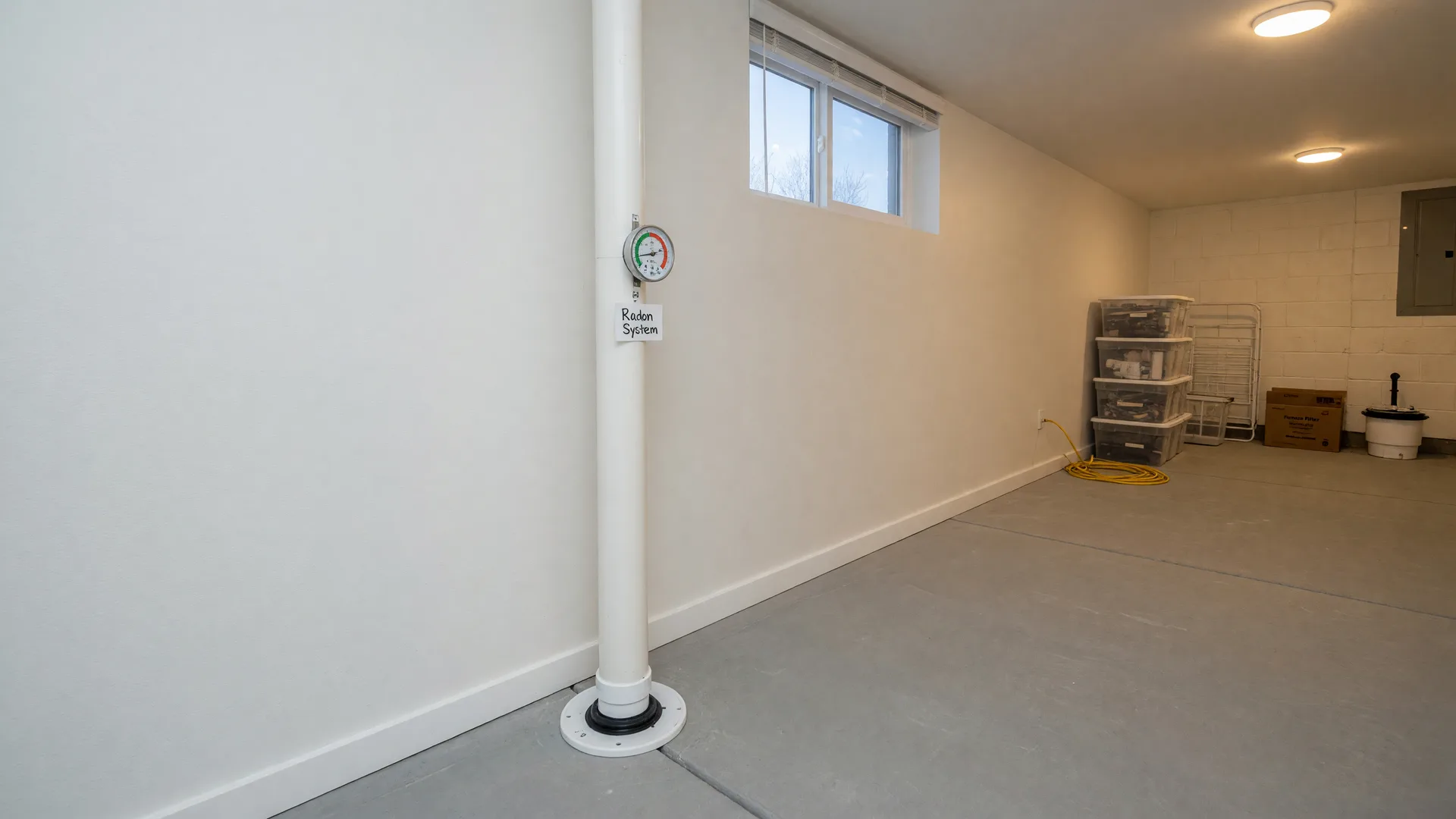
Most elevated readings in Sioux Falls are fixed with a sub-slab depressurization system. A licensed mitigator installs a pipe through the basement floor into the gravel beneath the slab, and a small fan draws soil gas out from under the house and vents it safely above the roofline. It is not a basement remodel and it is not disruptive; the system is usually installed in a day, and the fan runs quietly and continuously.
A typical sub-slab system in Sioux Falls runs about $1,000 to $1,500, and the South Dakota Department of Agriculture and Natural Resources publishes a statewide average installation benchmark of about $1,200. Quotes commonly range from roughly $800 to $2,500 depending on the foundation type and how the pipe has to be routed. A reputable mitigator gives you a firm quote only after seeing the house, and the job is never complete until a post-installation test confirms the level dropped, typically well below the 4.0 action level.
What I Recommend to Every Sioux Falls Buyer
Put radon testing in your offer from day one. Ask your inspector to add the 48-hour radon test to your inspection, which in this market costs about $100 to $120 on top of the inspection fee. If the reading comes back at or above 4.0, we ask the seller to install a system or credit you an amount backed by a real local quote, and we handle it like any other negotiation during your inspection contingency. If the house already has a system, confirm it is running, find out when it was last tested, and ask for the most recent result.
This is one of those few-hundred-dollar decisions I have never seen anyone regret. You either get a low number and close with total peace of mind, or you get a high number and fix it for about what a good washing machine costs. Either way, you know more than the seller knew, and you are moving into a home with the condition resolved instead of discovered later.
Questions about a specific home or a test result? Reach me at 605-214-6482, or book a conversation and we will walk through it together.
Frequently Asked Questions
Is radon a problem in South Dakota?
Yes, more than in most states. South Dakota has the highest average indoor radon level in the country, at about 9.8 pCi/L statewide, and roughly 6 in 10 tested homes come back above the EPA action level of 4.0 pCi/L. Minnehaha County, where Sioux Falls sits, is an EPA Radon Zone 1 county, the highest-risk category, with an estimated mean indoor level around 6.5 pCi/L from nearly 2,000 pre-mitigation tests. The levels vary from house to house, but the odds of finding an elevated reading here are genuinely high, which is why testing matters.
Do I need a radon test when buying a house in Sioux Falls?
A radon test is not legally required to buy or sell a home in South Dakota, but I recommend one on every purchase in the Sioux Falls area. A professional 48-hour test typically runs about $100 to $170, and often less when it is added to your home inspection. Levels vary from one house to the next, even on the same street, so the only way to know what you are dealing with is to test your specific home.
Can you still buy a house that has high radon?
Yes, you can, and most buyers do. Elevated radon is not a permanent problem, it is a fixable condition. A sub-slab mitigation system is a routine, proven installation in South Dakota and almost always brings the level back below the EPA action level. High radon is usually handled the same way as any other inspection finding: the seller installs a system, offers a credit, or you adjust the price, and the home closes with the fix in place or scheduled.
Who pays for radon mitigation, the buyer or the seller?
There is no fixed rule, it is negotiated, and in this market sellers usually end up addressing it. Most closing-friendly outcomes are either the seller installing a system before closing, or the seller giving the buyer a credit so they can choose their own licensed mitigator after closing. We bring real quotes into the negotiation during the inspection period, and the answer usually comes down to the price of the home, the test level, and what both sides agree is fair.
Does South Dakota require radon disclosure when selling a home?
South Dakota does not require a radon test before selling, but sellers are required to hand the buyer a completed Seller's Property Condition Disclosure before a written offer is made, and that form specifically asks whether the seller knows of radon in the house. So a seller must disclose radon they actually know about, but the form only covers what they know. It can never take the place of a fresh test, because many sellers have simply never tested.
How much does radon mitigation cost in Sioux Falls?
A typical sub-slab mitigation system in Sioux Falls runs about $1,000 to $1,500, and the South Dakota Department of Agriculture and Natural Resources lists a statewide average installation benchmark of about $1,200. Quotes commonly range from roughly $800 to $2,500 depending on the foundation type and how the system has to be run. It is a meaningful line item, but small next to the cost of the home, and it is a one-time fix backed by a post-installation test.
Every home is different, and every test result has a practical answer. Call 605-214-6482 or book a conversation and let's talk about your situation.